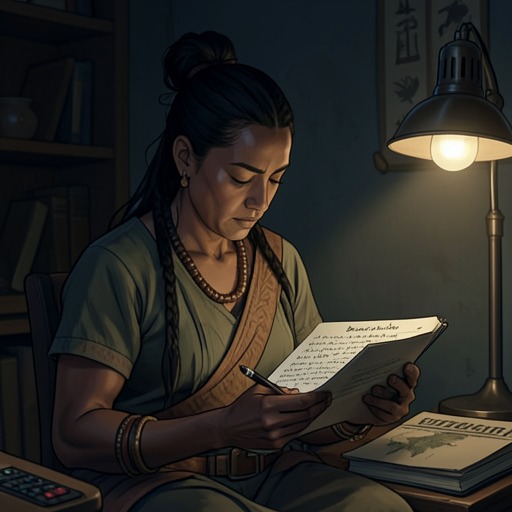
Preserving memory through written records
Even If This Love Disappears From the World TonightPreserving memory through written records is the novel’s practical answer to Maori Hino’s nightly loss of newly formed memories—and a recurring question about who gets to preserve, revise, or recover a life. Her binder and journal help her learn herself again each morning; after Tooru Kamiya’s death, the same documentary system is deliberately altered to hide him. Yet records do not contain memory whole: a sound, a place, and drawings eventually help Maori recover a relationship that the written archive had been made to obscure.
The Binder and the Daily Record
Maori’s binder is designed to make information retrievable rather than merely stored. She recognizes neither the binder nor its history when she first turns to it, but its simple appearance appeals to her; pages can be added, and projecting tabs make topics easy to find. Her mother explains that Maori usually takes notes on her phone and transfers the important information to the binder so that it will not be lost with the phone’s data. The arrangement distinguishes a portable record from a more durable summary, and turns the binder into a guide for someone who must repeatedly encounter her own life as unfamiliar information.
The first tab, marked “Important,” gives Maori the essential facts: she was in an accident, has a disability, and has told only her parents, Izumi Wataya, and her teachers. It also records why she has not disclosed her amnesia to classmates. Her family and the school discussed her condition, including the rule that she can graduate if she attends school for the required number of days, and the administrators warned that news of her memory loss could expose her to unwanted attention or danger. The binder therefore preserves not just medical information but the reasoning behind a decision about privacy. It helps Maori understand both what she is living with and why others have chosen to manage its disclosure carefully.
The journal supplies a different kind of record. Its entries begin the day after the accident and continue to the present, with weekly summaries that let Maori review events quickly. Unlike the binder’s condensed, practical account, the journal is informal and emotionally expressive. Maori first scans the summaries, learning that she has tried to keep her old routine so others will not notice that she is different; then she reads individual entries from May 27, the day she met her boyfriend. The two documents thus divide the work of continuity: the binder organizes durable facts, while the journal gives days their particular sequence and feeling.
Reading Herself Through Tooru
The boyfriend section offers a striking contrast to the account of disability and risk. After reading the “Important” tab, Maori feels overwhelmed by how narrow her future appears, but the binder points her toward a section about her boyfriend and the diary entries beginning May 27. She then reads a profile of Tooru, including details such as his birthday, family structure, blood type, favorite author, and personality. A note about his distinction between cleanliness and sanitation catches her attention and makes her mildly interested in him before she has met him anew through the journal.
As Maori reads the entries, the diary’s ordinary details—school, dates, Izumi, black tea—become evidence of a life she cannot recall directly. The record does not make every part of that life happy: it also preserves her disappointment that the advanced class she worked to enter now seems meaningless, her concerns about friends, and the lack of improvement in her memory. But after she begins dating Tooru, its emphasis changes. It records what they discussed and how cute he looked at particular moments. Learning that the relationship felt comfortable helps the present-day Maori feel braver, even though she is encountering those feelings as written testimony rather than as recollection.
The daily practice continues beyond the first morning of reading. In a journal entry dated June 9, Maori notes that riding a bicycle can feel new again even when she has done it before; each repeated experience is enjoyable in its own right. She thanks her boyfriend for the day, then later reads the entries and blushes at how girlishly excited she sounds. A folder on her phone labeled “My Boyfriend” contains photographs and videos of Tooru. One shaky twilight video, filmed while they ride together, shows him glancing back as he pedals and captures her own flirty voice. The journal tells her what happened; the recording lets her hear the happiness in it. Neither eliminates the gap between the self who lived the moment and the self who reads about it, but together they give that gap a shape she can approach.
Records as an Archive Others Can Change
After Tooru dies, preserving the record becomes inseparable from deciding what Maori should be able to know. Izumi Wataya tells Tooru’s sister, Keiko Nishikawa, about Maori’s binder and journal, the risk that distress could contribute to depression, and Tooru’s request that he be erased from the records. Keiko offers to type the documents into a computer and repair the passages where his name and presence are removed. The proposal treats the archive as editable: its continuity can be maintained even while particular facts are excised.
The alteration extends beyond the paper records. Tooru appears in photos, videos, messages, and conversations on Maori’s phone, so Izumi and Keiko arrange for a new phone and plan explanations for the missing data. On the morning of the third day after Tooru’s funeral, Izumi gathers the binder and the many volumes of Maori’s journal from her desk. He transfers the digital journal and notes Keiko has prepared to Maori’s computer; Keiko has added entries for the days since Tooru’s death and falsified the document timestamps so the files will appear consistent. Izumi also deliberately disrupts the transfer to a new messaging app, removing the old exchanges that mentioned Tooru. The changes are meant to leave Maori with an apparently continuous account of daily life, but one from which a central relationship has been systematically removed.
A hidden note resists that erasure. While replacing Maori’s reminder sheets with printed versions, Izumi discovers a sticky note on the back of one: “Even if I recover, always remember Tooru Kamiya. The important things will always be in an important place.” He suspects she positioned it so she would see it when taking the paper down, perhaps anticipating recovery, though he cannot be sure what she knew about the alterations. The placement matters: the message is not among the visible, organized notes but on the reverse, waiting to be found. Even as the records are being edited to protect Maori from pain, the note records her own insistence that Tooru remain recoverable.
From Documentary Clues to Chosen Memory
Once Maori no longer has amnesia, Izumi recognizes that there is no longer the same reason to conceal the truth. Still, when she asks about a drawing of Tooru, he tells her that Tooru was merely someone she saw a couple of times at the library during summer break in high school. He knows she has completely forgotten Tooru and fears that a fuller account might hurt her; he also imagines that she could later have a boyfriend or husband and leave the unexplained sketches behind. His answer shows the limit of the archive’s caretakers’ authority: even when trying to spare Maori pain, they must decide whether a protected life is worth the loss of her own past.
Maori does not simply treat the surviving photographs and videos as a shortcut to recollection. She worries that seeing them might replace her own image of Tooru with the version fixed in the recordings, and says she is afraid of remembering only the images. At Izumi’s suggestion, she agrees instead to listen to audio extracted from a video. The file begins with rattling, her happy squeals, and wind; as she listens, she gradually remembers the day she insisted they ride a bicycle together. The recording does not hand her a complete memory. It provides a sensory cue from which a particular experience begins to return.
The process continues over years, not in one instant of recovery. Three years after Maori had declared that she would remember, she is in her fourth year of university and still trying. She revisits places she and Tooru went and repeats things they did, guided by her journal and Izumi’s stories. The effort does not work as simply as the Lady Grey tea, but she persists, searching within herself for her forgotten past. Her own declaration that she is alive and will remember is the beginning of a long attempt, not a promise that documents can fulfill on her behalf.
At the cherry-blossom park, her drawings make the change visible. Izumi sees images of Tooru that he has never seen before: unlike the shy or faintly smiling Tooru in the old sketchbooks, these show him as Maori remembers him. The drawings are not simply copies of an existing archive; they give form to a memory that has returned to her. Looking at the cherry trees, Maori seems to be trying to recall something, and then the time she spent with Tooru replays in her mind. She says she has remembered more, though not everything, and describes their love as something still sleeping in her body and heart. Remembering him lets them continue to live together in a changed sense—not as a denial that he is gone, but as a connection carried within her.
The novel’s records are therefore both essential and incomplete. The binder preserves facts and the reasons behind choices; the journal gives repeated days an emotional history; a phone folder and an audio file provide images and sounds; a hidden note preserves a wish that the edited archive would have suppressed; and drawing expresses a recollection no one else can supply for Maori. Written records make continuity possible across her daily reset, but the story distinguishes access to information from the experience of remembering. Maori’s final movement is not merely to receive an intact past from others: it is to choose to seek what matters, accept that recovering it may hurt, and let remembered love coexist with the possibility of a future life.